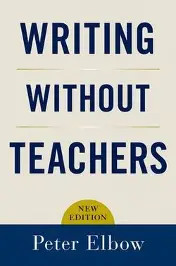
Not long ago, I was searching for ways to improve the way I teach peer writing groups in the classroom, when I came across the work of Peter Elbow. I had heard of his famous 1973 book, Writing Without Teachers, often mentioned in the same sentences as Don Murray’s A Writer Teaches Writing. It was clearly an important book in the process writing movement, and I’m not sure why I hadn’t gotten around to finally reading it until this year.
But it was in hunting for ideas about writing groups that I came across Elbow’s writing group principles somewhere else – it was in one of the written-for-ELA-teachers books that I have. I forget which. But the author was talking about just the same problem I was having: that peer writing groups among my students were not attaining the results they should be. The writer described the changes he had finally made, and it seemed like many of them involved embracing some of Elbow’s ideas about running writing groups. This was welcome, because most of the other information I found about peer feedback was mostly just melted down group work advice. Elbow’s stuff was aimed at writing groups, and it seemed interesting.
The main thrust of Elbow’s work, as I could see it at first, seemed to be for peer reviewers not to simply try to “correct” their fellow students’ work, nor even to offer feedback and good and bad aspects of the work, but to relate, in a fairly descriptive fashion, what Elbow called “movies of their minds” – their subjective experiences of what they felt or thought while reading their peers’ work. Elbow had distilled this down into a number of different specific response types that students could request from their peer readers, the two most important of which were “pointing” (which involves “pointing” to words or phrases in the work that particularly stood out to them), and “summarizing” (which asks readers to summarize the main ideas they heard in the writing).
I was struck by the notion of allowing readers to choose what type of feedback they wanted from readers as much as I was by the particular categories, and so I made up my mind to adopt these elements into my own teaching practice. But in my daily practitioner’s time-strapped, I’ve-got-classes-coming-in-on-Monday-morning haste, I just threw his ideas into place without really taking the time to examine the underlying philosophy. But recently I had a chance to go back and really read his seminal Writing Without Teachers. His philosophy, especially as distilled in his classic and I think underappreciated “appendix essay”: “The Believing Game” – is worthy of study.
Elbow’s basic educational philosophy is that writing is communication and that what writers need in order to improve is a kind of personal reaction to their words, just as we’d need a reaction to our spoken words to learn how to speak. Elbow is not interested in traditional feedback, focused on how to write well or not, preferring feedback-givers proffer, as mentioned above, “movies of their minds” – a more authentic, personal response to the work that is descriptive rather than prescriptive. The idea is that readers are responding authentically as humans, showing you what human effect your words have on them, rather than responding intellectually with theories about how to write.
Elbow uses the metaphor of a person attempting to learn how to speak in a void, without any other humans present; this person would not have the opportunity to learn how others respond to their words and therefore would not learn to speak. It is the same with what he seeks from readers: What words or phrases really “got through” to people? What did they understand the writing to be about? What was their own personal reaction to the writing?
Elbow at one point even goes so far as to say that traditional teacher feedback should follow more along these lines, too. He says that teachers rarely react as humans to the writing that they read, describing the emotions they felt while reading – although he admits that sometimes these types of reactions might be considered “unprofessional.” But again, teachers are not really Elbow’s focus – they are not part of the ideal that he describes in the book, what he calls a “teacherless writing class” – essentially a group of peers who get together to read and share their work with each other. And because Elbow is writing about what is essentially a kind of ideal writing community, I did take his book as something of a didactic rather than practical text. It’s hard not to admire much of his advice – especially his notion that it is important to get immediate, real-time, face-to-face feedback on how our words affect others. I think this is especially important in our own digital age, when too much of our communication takes place from behind screens.
That said, I found myself not entirely going along with all of Elbow’s ideas. Peer feedback is thorny for anybody, but especially for teenaged high school students. You have to be careful about empowering or even allowing readers to respond with their unvarnished, instinctive thoughts, which can very quickly become unfair to the writer, turn into a pile-on session, lead to bad feelings all around, etc. Elbow writes in the book several times about the notion that writers need to be completely open to all kinds of subjective and even, it is implied, harsh, feedback. Elbow has a variety of important more philosophical reasons for this (more on this below), but ultimately what he requires of writers and sharers in his teacherless class is a pretty thick skin.
He also writes in a fairly idealistic fashion about how valuable a person’s in-the-moment, relatively unstructured and sometimes quite partisan feedback is – more valuable, perhaps, than a judicious and impartial teacher’s more thought-through, considered feedback. Yet I have seen and even been part of many writing groups in which the readers clearly don’t “get” the piece being read. They don’t appreciate a heartfelt, well-written essay for a variety of reasons: they are distracted, incurious, inadept at listening or reading along, strongly biased against the subject matter. Many of the responses they would provide in these situations are, when I have seen them, often deeply unfair to the writer, and often cause the writer to lose heart, feel defeated, become defensive or angry, or to shut down going forward. I have seen this in settings with children and with adults.
Elbow does not seem concerned. Again, he seems to require very tough skin. His advice, essentially, is that writers should simply try to not only listen to harsh feedback, but to try consciously to “believe” it – to take it as true, or at least to try to see the advice and the person giving it for what they are (often particularly partisan or partial). Take it for what it is, he says, as feedback from that particular segment of highly partial humanity. That person clearly has an axe to grind, you must remember, and it is not about you, but that is simply unvarnished data for you, as a writer, about how your message will land with this particular sub-group. That is a hard standard to live up to – for anyone, adult or child. Much better, I believe, to put some guardrails on the practice and to require a basic level of attention, civility, decorum, and compassion, rather than just asking for unvarnished reaction.
This is all based on a deeper philosophy that Elbow has, of course: The notion, outlined in the book’s Appendix Essay, that the way to understand not only the impact of our words – but to understand truth itself – is to practice “believing” rather than “doubting.” He terms both approaches “games” – as in, the believing game versus the doubting game. The doubting game he identifies with traditional, Enlightenment-era skepticism, the basis for modern science. The doubting game requires us to look for errors; whatever is left over is accepted as (often provisional) truth. The believing game requires us to believe everything – to “get inside the head of someone who saw things this way” (149), as Elbow puts it. The doubting game, through its use of evidence and logic, is often an inadequate way to identify truth as expressed in speech and literature, where the meanings are more subjective. Elbow is not the first thinker, surely, to have this insight, but his thought is useful because here he proposes his “believing game” as a better model. The idea is not to seek to disprove an interpretation, but to believe it completely and therefore to understand it completely, to the point where because we understand it so thoroughly, we can tell whether it is in fact true or not. Essentially what this is doing is allowing us to take a very deep, careful look at an assertion, without dismissing it out of hand. As Elbow writes, “ . . . If we had started doubting we would have found so many holes or silly premises we would have abandoned it. Only by getting far enough into it could we get to the point where there was sufficient evidence and understanding to show that it was indeed true, and this was only possible by believing it” (163). This is similar to John Stuart Mill’s belief that our certainty of truth is only improved by a comparison with error. Elbow writes, “This then is the leverage of the believing muscle: believing two things and thereby being able to have a trustworthy sense that one is better than the other” (163).
The two things to watch out for in playing the believing game, Elbow writes, are blindness and projection. If you are blind to the meaning of a particular argument, you are simply not understanding it well enough to assess its truth. Same goes if you are projecting your own meaning that is not there, which Elbow cites as an especially dangerous temptation to novice practitioners of the game itself: “It takes practice over time to learn not to ‘project’ in the bad sense – not to see only your own preconceptions or preoccupations; and to learn to ‘project’ more in the good sense – to see more of what’s really there by getting more of the self into every bit of it” (171).
Elbow also identifies the rules of the believing game: don’t argue with people, always agree, try to make metaphorical projections to enter better into their thoughts (this is important for Elbow – he often uses the technique in his own writing, in fact), try to put yourself in the other person’s perspective or positioning.
I found all of this to be very interesting, and it all holds together surprisingly well, philosophically. The notion of embracing new ideas and new perspectives by doing your best to imbibe them whole, to believe everything – without being naive or credulous – does indeed seem to me a powerful way to understand diverse perspectives. In fact, it seems to me the kind of “suspension of disbelief” that is required to enter into stories or narratives of all kinds – the type of mindset that allows us to truly understand those who are different than us.
How all this connects to the notion of providing descriptive feedback is an interesting question, and I found it a little hard to toggle back and forth in my own “believing game” between Elbow’s philosophical claims in the Appendix essay and his more practical prescriptions toward subjective, experiential opinion-giving in the sections of the book on peer writing groups. Often what writers want is feedback that will help them move forward to help their writing improve, rather than descriptive data about what readers did or did not have sink in.
Either way, Elbow’s system is all very unique, and I’ll certainly be thinking more and more about this all going forward, especially as I continue my own tinkering toward utopia in the classroom.