There it is, the book on my shelf from college: Rationalism in Politics and Other Essays, by Michael Oakeshott. And there is his name, woven through the work of Andrew Sullivan – an entire PhD. dissertation, in fact, on Oakeshott. There he is, one of the most esteemed conservative thinkers of the 20th Century – with a whole book collection of his writing about education – The Voice of Liberal Learning. By now, I have read widely, sympathetically, in his work, and I have tried hard to give it a fair hearing. But even after all this, I find that my opinion on the man’s work is unchanged from twenty-plus years ago. I am afraid that when it comes to why Michael Oakeshott is so admired, I have only one response: I just don’t get it.
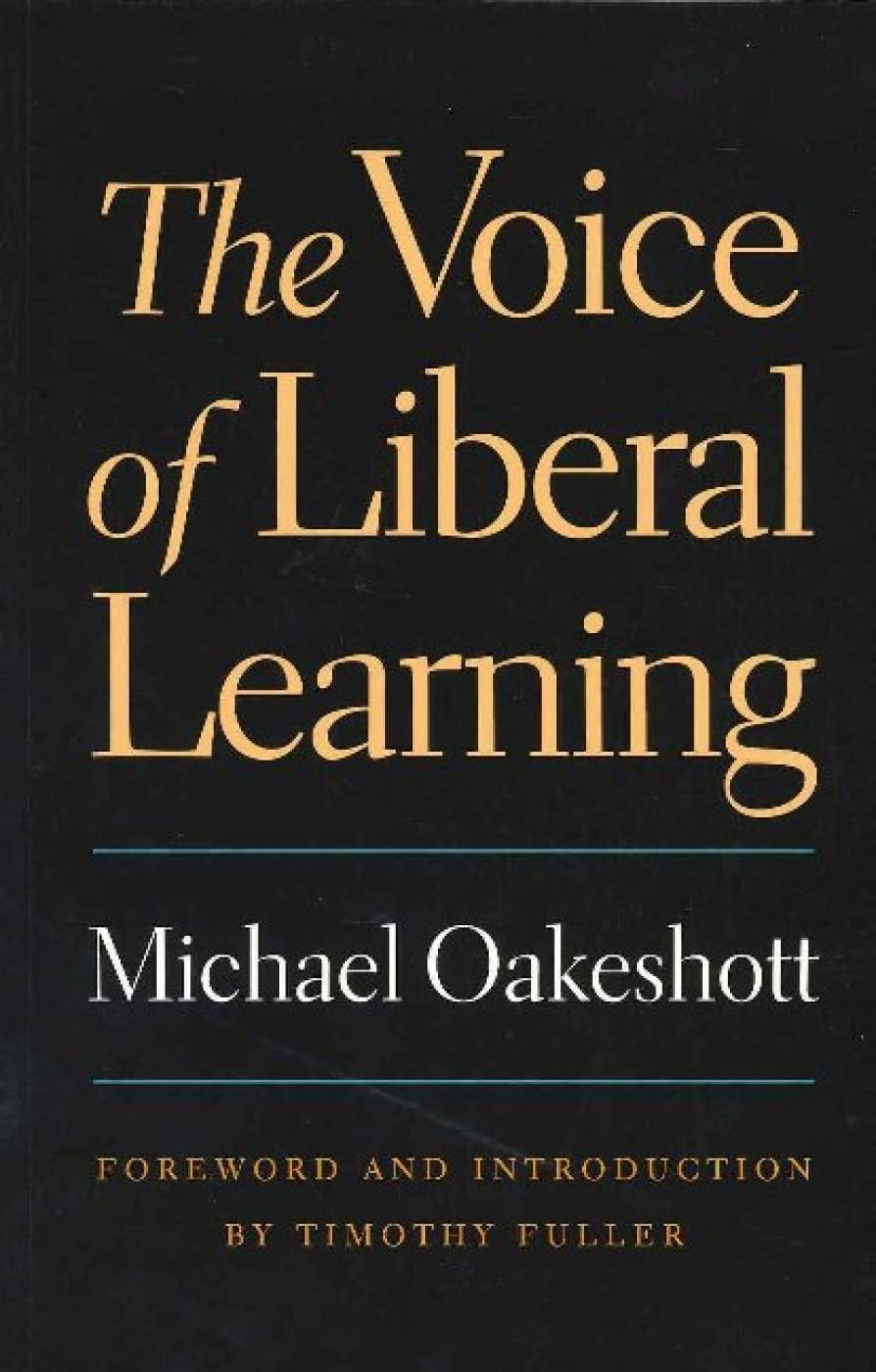
This is particularly true of The Voice of Liberal Learning, which I have just finished re-reading. It’s not that I particularly disagree with anything he writes. Although he is a wonderful writer and a gifted stylist, his work is quite obscure at first. There is, in my view, a simple, fundamental reason why, and I will describe this below. But once one uncovers this, and begins to understand what Oakeshott is really saying, the real problem emerges: In my view, there is just not a lot going on in his work.
But let’s see what he is actually saying.
***
Oakeshott can be very misleading. At first he seems like a straightforward educational perennialist. Much of his writing seems, at least at first, to be a fairly familiar and straightforward defense of traditional liberal arts learning. In one of the book’s essays, “Education: The Engagement and Its Frustrations,” there is much fairly middle-of-the-road vaguely conservative critique of education-for-utility. Perhaps it was fresh at the time, but most of it seems tired – and, if you have the best of John Dewey in mind, cynical. I’m not bothering to quote any of it here, because you’ve read this sort of thing before: education should not be technical training, education should not cater to the marketplace, etc., etc.
This was particularly unsympathetic to me because, like Michel Foucault, Oakeshott is much clearer in this essay when discussing what he is against than what he is for. Volume alone tells us much: “Education: The Engagement and Its Frustrations,” is forty pages long, but only the first ten outline Oakeshott’s vision of what education should be, while the final thirty represent his attacks on others. Beyond this, the writing itself, when he turns to what he believes education to be, becomes vague and metaphorical. He writes often of education as a “transaction” between generations, and that humans are “initiated into the world they inhabit” (62). The goal of education is a “recognizably human life,” because humans “pursue satisfactions which they believe to be desirable” (63).
But although he repeatedly uses the metaphor of education as an “inheritance,” it becomes clear that Oakeshott is not trying to stake out the high ground of perennialism. He does not talk about the goals of education being a study of the Great Books, or capital-T Truth. Instead, Oakeshott dissolves into vagaries about “states of mind” which are “understandings” and how to be human is to “engage in activities knowing what you are doing” and that education’s goal is “learning to perform humanly” (67). One of Oakeshott’s techniques, when faced with the need to outline exactly what it is that he believes education should focus on, is to offer up a list, as though trying to move past what he already thinks we understand. He writes:
“Education is not acquiring a stock of ready-made ideas, images, sentiments, beliefs and so forth; it is learning to look, to listen, to think, to feel, imagine, to believe, to understand, to choose and to wish” (67). This is poetic enough, but short on substance.
Again, so much of Oakeshott sounds like Perennialism – with all of the talk of education as a “summons” or an “inheritance” or an “initiation” into a “conversation.” But Oakeshott is not Leo Strauss. There is no talk about “the ancients.” The “conversation” is not one between “the great minds.” It is more obscure than that.
In a way, it’s as though Oakeshott wants perennialism, just without the part about an enduring human nature. He writes often about true education as liberating us from “contingency” or “convention. But it’s as though he wants to liberate us from convention in order to contemplate a wholly contingent and ever-shifting culture, which he says we must “participate” in. Several times he writes that there is no enduring human nature, but he often talks about human self-understanding, which makes one wonder just what this understanding comprises. He says for instance, that “liberal” education should be focused on “human self-understanding” (15), which he defines as “the actual inquiries, utterances and actions in which human beings have expressed their understanding of the human condition” (15). This is a “liberal” education, for Oakeshott, because this education is “liberated from the distracting business of satisfying contingent wants” (15).
But again, this is not perennialism – not exactly. Just after this, Oakeshott writes that liberal education “does not” provide “reliable information about ‘human nature’” because “There is no such thing as ‘human nature’; there are only men, women and children responding gaily or reluctantly, reflectively or not so reflectively, to the ordeal of consciousness, who exist only in terms of their self-understandings” (15).
***
So what is Oakeshott after, really? One of the places we may really get to heart of his thought is by examining his repeated rejection of abstract knowledge in favor of practical wisdom. This is well-expressed in an interesting passage in “The Idea of a University”:
“It is a favorite theory of mine that what people call “ideals” and “purposes” are never themselves the source of human activity; they are shorthand expressions for the real spring of conduct, which is a disposition to do certain things and a knowledge of how to do them. Human beings do not start from rest and spring into activity only when attracted by a purpose to be achieved . . . The purposes we attribute to particular kinds of activity are only abridgements of our knowledge of how to engage in this or that activity” (105).
I like and agree with this – to a point. Yes, it’s true that we rarely consider the (sometimes highfalutin) purpose statements of an organization to guide our daily conduct or actions. But I don’t think Oakeshott particularly adds much on what *does* guide us. “A disposition to do certain things” means – what exactly? If Oakeshott is saying that, for instance, pure, base instinct guides our actions, surely that is less preferable than the alternative. After all, there is much to be said for the fact that we *should* do more to keep in mind the goals and purposes of an organization before taking action.
He cites an example: “A cook is not a man who first has a vision of a pie and then tries to make it; he is a man skilled in cookery, and both his projects and his achievements spring from his skill” (106).
Yes – to a point. It’s true that abstract visions do not necessarily provide the sole starting ground for a project. And it’s surely true that our visions of pies are shaped by our experience – we generally do not have visions of foods we have never encountered. But it’s banal to the point of meaninglessness to say simply that one’s achievements spring from his skill. Of course. But there’s more to it. For instance, cooks do have visions of pies they want to make – how else would they realize that they need to perfect their recipes or efforts? – and they do spend time and energy trying to make those visions into a reality.
There are other, slightly different claims:
“A university is not a machine for achieving a particular purpose or producing a particular result; it is a manner of human activity” (106).
Or: “A university is a number of people engaged in a certain sort of activity: . . . we may call it ‘the pursuit of learning’” (107).
Again, I agree and disagree – yes, a university can be considered a manner of activity, but it’s not a manner of activity without a purpose.
Or: “[Universities] may not know what they are ‘for’ . . . but I think they do know something that is much more important – namely, how to go about the business of being a university. This knowledge is not a gift from nature; it is a knowledge of a tradition, it has to be acquired . . . It is only by exploring this knowledge . . . that we can hope to discover what may be called the ‘idea’ of a university” (106-107).
While I have the same objections to this passage as to the ones above, this one does demonstrate that Oakeshott, like Burke, views knowledge inherited from tradition as being important, but he’s not as forthright or straightforward about it as Burke. Burke sees this sort of knowledge as having grown up organically, and therefore being sturdy and trustworthy (especially compared to rationally-derived knowledge) and therefore more *true*. Oakeshott is much more oblique; he seems far less comfortable with the notion of truth (even hard-one or practical). Instead, he seems to see tradition not as a set of tried-and-true practices, laws, or institutions (like Burke), but as a kind of accumulation of understandings about the human condition – and he seems very uncomfortable saying that any one of these is necessarily more true than another. He uses different metaphors to indicate this cacophony: “voices” from the past, sometimes in a “conversation,” as in this passage from “A Place of Learning” in which culture is variety of “voices”:
“ . . . [E]ach the expression of a distinct and conditional understanding of the world and a distinct idiom of human self-understanding, and of the culture itself as these voices joined . . . in a conversation . . . in which we enter into a variety of modes of understanding the world and ourselves” (30).
And it is here that we seem to get to the heart of what Oakeshott believes should be the goal of education, and here we get to the substance of his perennialism. While Oakeshott does not talk like most perennialists, of “enduring questions” facing humanity, or of enduring predicaments, or of the natural tendencies of human nature, he does speak of our “modes of understanding.” For Oakeshott then, the goal of liberal learning is understanding these apparently fundamental “modes” of understanding. These modes are not only different subjects of study, but they are different, irreducible ways of understanding the world: “. . . The language of the natural sciences, the language of history, the language of philosophy, or the language of poetic imagination” (28).
Each mode is conditional – that is, it does not have any sort of monopoly on the truth. They are also irreducible – they are not debating each other. In fact, he writes, “they are incapable of refuting one another” (30). Instead, they are different lenses, each with its own presuppositions and starting points. In fact, it is not even clear that new thinking or expression within each mode can constitute or even get closer to the truth . Oakeshott’s “inheritance” is not comprised of ever-truer or more-true understandings, but, as he phrases it in this essay, merely “beliefs” or “expressions” (38) or “achievements” (39).
True liberal learning is the attempt “to recognize and discriminate between these languages of understanding . . . becoming familiar with the conditions . . . and is learning to make utterances . . . that display genuine understanding of the language spoken” (28-29). And to “learn to recognize the voices; to distinguish their different modes of utterance, to acquire the intellectual and moral habits appropriate to this conversational relationship and thus to make our beginning in human life” (30).
Here we begin to understand Oakeshott’s obscure perennialism even further: Not only are these modes fundamental and enduring, but they are not necessarily ever-improving and ever-truer discourses. They ebb and flow – sometimes older (and possibly better or more true?) expressions of each mode are lost, and must be recaptured through historical study. Oakeshott writes: “But since none of these languages of understanding was invented yesterday and each is the continuous exploration of its own possibilities, a learner cannot expect to find what he seeks if he attends only to contemporary utterances” (29).
Just as Dewey does not deny the importance of stable truth but seems to relentlessly downplay it, Oakeshott does not seem willing to dispense with the notion of truth, but seems uncomfortable with it. I do not get the feeling that he is a relativist. I get the sense (although he does not acknowledge this, at least in this book) that he is far more modest. It is an interesting stance – and this is what makes him, for me, such an obscure thinker: He does not come out and say we must be modest and conditional because truth is hard. Burke says that. The Pragmatists say that. Scientists say that, at their best. But Oakeshott never does. Because he is so modest, he seems like a strange cross between a perennialist and relativist – it’s as though he’s merely searching back through history for the most compelling opinions, while trying his best to stay out of judging whether any are more true than others.
The only truth claim he is comfortable with is methodological: that the modes of understanding are tried and true, and therefore we must teach students to understand, interpret, and ultimately contribute to them. Ultimately then Oakeshott’s educational goals are not particularly controversial or unique: Students must learn the best or most important examples of expression in the “modes”: presumably that means studying the most compelling theories in science, in history, philosophy and poetry – and then learning to do their own work in these disciplines.
It’s a solid and straightforward theory – it’s just obscure because Oakeshott – whether from modesty or otherwise – is uncomfortable with truth. He lands somewhere on the continuum between a straight-up Pragmatist like Dewey (for whom the contemporary world and its problems is all there is) and a Great Books-style Perennialist like Mortimer Adler (who has no problem talking about truth). As it is, I find his educational goals a watery mix between the two, ultimately obscure, and not all that insightful.
What about his methods?
***
So if the substance of education for Oakeshott should be understanding and learning to contribute to the sum total of our “inheritance” of the “voices” in the “conversation” of humankind – as expressed through the various “modes of understanding,” what then are the proper methods for teachers to go about that?
Once again we find fairly straightforward and conventional ideas that are at first obscure because of Oakeshott’s discomfort with truth. What you see at first appears to be a substantive claim: Oakeshott’s strong belief in the importance of practical knowledge over abstract theory. Here again, Oakeshott seems like something he is not. At first, he seems like a reluctant Pragmatist. What works is what’s true, he wants to say, but again, he can’t bring himself to use the word “true.” So at first he sounds – and I hate to say this – ever-so-slightly anti-intellectual. That sounds harsh, but Oakeshott often seems to disparage knowledge in favor of day-to-day unexamined practical activity.
But dive deeper, and things become far more conventional. In the essay “Learning and Teaching,” Oakeshott distinguishes between what he calls “information” and what he calls “judgment.” Here he makes a familiar insight: Information, although important, is not necessary to be good at something. He reminds us, for instance, that knowing the principles of motion or gravity is not required to be good at riding a bicycle (48). Instead, as he puts it, “Before any concrete skill or ability can appear, information must be partnered by ‘judgment,’ ‘knowing how’ must be added to the ‘knowing what’ of information” (49). Judgement “cannot be resolved into information” but is also not synonymous with “knowing how.” Instead, judgment is “knowledge which enables us to interpret” information and to “recognize what rule to apply” and “to decide” what knowledge is “relevant” to a given situation. Judgment, therefore, is recognizable to a modern educator’s ear as the kind of “transferable skill” that allows us to use or employ knowledge: so-called cognitive “skills” like problem solving, critical thinking, interpretation and evaluation. Think of Bloom’s Taxonomy.
Oakeshott believes that information and judgment cannot be acquired separately (a familiar theory to many educators, again), and suggests that that teaching has two components: “instructing,” which communicates information, and “imparting,” which teaches judgment, and which must be imparted through the course of learning, indirectly, as it were, in situational settings. Oakeshott is again rather poetic (if not obscure) about how judgment should be imparted. In a fascinating passage, he writes about teaching by example, which he offers as an important way to teach judgment:
“For ‘teaching by example,’ which is sometimes dismissed as an inferior sort of teaching, generating inflexible knowledge because the rules of what is known remain concealed, is emancipating the pupil from the half-utterances of rules by making him aware of a concrete situation. In imitating the example he acquires not merely a model for the particular occasion, but the disposition to recognize everything as an occasion” (60).
There is much to admire in this passage, which I believe represents the heart of Oakeshott’s teaching about education. He is not anti-intellectual, after all. Rules must be taught – otherwise we are groping around in the dark. But the rules make only “half-utterances” – what a beautiful phrase – that bind us in metaphorical shackles until we are “emancipated” from them by an instructor “imparting” practical advice (which is to say the ability to interpret and evaluate the “rules” for a specific concrete situation) – which helps us confront not only the current specific situation, but future ones.
Oakeshott does not believe that abstraction has no place in learning – but that “judgment” – the ability to discriminate, to think critically, to select and apply rules judiciously – is best learned situationally, concretely, and indirectly. I think here of the master woodworker helping an apprentice – not only stepping in and showing him how to approach a certain situation that is unclear, but also allowing the novice to oversee and overhear the master’s metacognition as it were: His own approach to specific challenges. Again, this sort of metacognitive apprenticeship is very familiar to modern educators, and is not far off from Vygotsky’s “more capable peer.” Oakeshott’s gift is to remind us that one does not become a good cook by following the rules alone – he must learn how to interpret the rules by practicing and by working with an experienced chef.
***
What value is there in all of this? Not much, in my view. I see very little in Oakeshott’s educational thinking that is not better expressed elsewhere. Dewey is much better on the interplay between our goals and our actions, Burke is far more compelling on the importance of tradition and organic knowledge, and any number of average writers and thinkers (to say nothing of Vygotsky) are far better on the importance of teaching by example. And the tension between eternal truth and wholly contingent knowledge is addressed with far more – I hate to say this, but honesty – by many, many other thinkers. Oakeshott just seems uncomfortable saying what he believes, and as a result, I did not find his work particularly forthright or insightful.
Ultimately when it comes to Michael Oakeshott, I still don’t get it.