One of the interesting things I’ve noticed in the last few years is that some of the most astute and interesting analyses of modern Critical Theory (CT) – whether podcasts, articles, or even books – actually come from the Christian right. I have also noticed that as the culture starts to catch up with CT, the books and articles that analyze the movement have begun to get more serious and are written by more qualified scholars and writers rather than culture warriors.
Both of these trends converge in a fascinating recent book called To Change All Worlds: Critical Theory from Marx to Marcuse, written by a British professor of religion named Carl Trueman. It is one of the most accessible and insightful analyses of Critical Theory I have ever read; that he wrote it explicitly for a Christian audience should not put secular readers off of this book either.
Years ago, as a student teacher, I was faced with the chore of having teaching high school juniors a book that I absolutely hated as junior: The Scarlet Letter. I had dim memories of slogging through the first third before giving up and faking my way through discussions of the rest of Nathaniel Hawthorne’s antiquated, lifeless prose. The stale comings and goings of ancient characters made me want to jump out the huge picture window in my English classroom and start running. The only thing that had stuck with me was how old the book seemed, how remote from me.
But being a 27-year-old reader is not the same as being a 17-year-old reader, and within minutes of reopening The Scarlet Letter again, I found myself riveted. Hawthorne’s prose wasn’t stale – it was fresh and vivid. The characters, who’d once seemed about 300 years old to me, suddenly drew into focus for what they were: young and vital, really the same age as I was. There was the sex, the lust — all of it simmering right below the surface, the chilling jealousy of the aptly named Chillingworth, the heroism of Hester Prynne in not giving up the name of her paramour. And then of course the remarkable sophistication – genius, even – of Hawthorne’s complex portrayal of the way that guilt can borrow into the human heart. If I’d had any doubt I wanted to be an English teacher that semester, it was gone within a few pages of rereading this old classic.
I read many of the Platonic dialogues in college, and I read The Republic several times, but I’d never read Meno, known to be one of Plato’s most influential dialogues on the field of education. After several false starts over the last few years, I finally got around to reading the whole thing. It is, like all of Plato’s work, at once simple and commonsensical, and yet rich and complex.
The main idea is that Socrates and Meno are – in true Socratic fashion – attempting to understand what arete (often translated as “virtue” but in the version I read as “excellence”) really is. As usual, Socrates is ostensibly trying to learn about excellence from Meno, who claims that he knows much and has spoken to great crowds about it before, but through Socrates’s dialectic questioning, it quickly becomes apparent to the reader and to Meno that he has trouble defining excellence. Socrates contends that this is the best approach:
“And the more dialectical approach is probably not only to give truthful answers, but also to proceed via whatever the person being questioned admits that he knows. So I shall endeavour to talk with you in this way too.”
But when Socrates proposes that this inability to define excellence on both of their parts should motivate them to search together for the truth, Meno replies by asking a fascinating question about how he and Socrates will know when they arrive at the truth – the so-called-Meno’s Paradox:
“We should, however, give to our children a vision of the possibilities which lie ahead and endeavor to enlist their loyalties and enthusiasms in the realization of the vision.”
– George Counts, Dare the School Build a New Social Order?
***
As I’ve just finished immersing myself in John Gatto’s powerful arguments for unschooling – the crux of which is that compulsory education is not to be seen as a lever of change, but as a fundamental imposition – I thought it was time to revisit what is perhaps the second most powerful (behind Paulo Freire’s Pedagogy of the Oppressed) call for educational social reconstruction that I’ve ever read: George Counts’s 1932 pamphlet “Dare the School Build a New Social Order?” While I’d read this years ago, I’d never written about it, while I’ve written at least two or three times about Freire. It was time.
Although it’s not nearly as long as Pedagogy of the Oppressed, Counts’s work is powerful, lucid, beautifully written, and direct. He begins by outlining the stakes that the country faces, the tremendous and grinding economic deprivation of the Great Depression. Then he moves on to chastising teachers, on the one hand, for their hitherto passive political role, and – famously, scandalously – the “child-centered” educational progressives who prioritize the individual comfort and security of their positions (and their children’s) over meaningful political engagement and care for the less privileged:
“The weakness of Progressive Education thus lies in the fact that it has elaborated no theory of social welfare, unless it be that of anarchy or extreme individualism. In this, of course, it is but reflecting the viewpoint of the members of the liberal-minded upper middle class who send their children to the Progressive schools.”
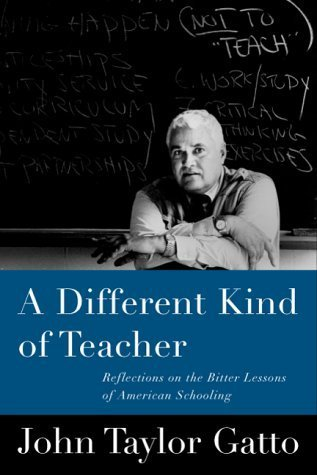
It’s not unusual that some of the most ardent school reformers are former educators. But it is unusual if they’re arguing not to reform school but to get rid of it.
But that’s John Gatto. He rose to fame in the early 1990s as a three-time New York City teacher of the year, and who became known for using the occasion winning New York State’s teacher of the year award in 1991 to announce his resignation from the profession because he no longer believed in compulsory education.
Even more unique are his reasons. Gatto’s thinking and writing – which proliferated upon his retirement – is a bracing mixture of historical perspective, hardcore and hard-to-classify political invective, and slice-of-life stories of hope and inspiration. Gatto’s an onion; keep peeling back the layers and he’ll more and more convince you that his criticism of public schools is one of the strongest, if most cynical, that you’ve ever read, one that deserves to be taken seriously.
Several years back, in a flurry of activity, I set out to read the fundamental books in the social contract tradition. I read Rousseau, I read Locke, and I read Hobbes. Around the same time, I set a goal of reading John Rawls’s A Theory of Justice, and I got as far as purchasing a copy and reading the first twenty or so pages before I was stopped by the wall of dense, complex theory and prose. There it was, staring back at me from my shelf, a tome, a massive reproach, a hole and a gap in my knowledge of 20th century philosophy.
As the parent of young children, I’ve found that my ability to read much of anything over the last few years outside of the materials I read for work has dwindled to almost nothing. I sometimes see friends posting year-end charts recording all the books they’ve read; my own, once robust, would look almost entirely blank over the last several years. My usual intake of reading material on nights and weekends includes little more than the instructional manuals of various appliances and power tools immediately necessary for household operations, peered at in the dim light of the basement or garage, with the kind of quizzical look on my face that wonders how it is possible that a snowblower’s carburetor can at once be intricate and unseeable by the human eye. For me, as a middle-aged father of small children, reading has become more of a utilitarian pastime.
Years ago, when I was first a teacher – which is to say, back before I had time to read books about teaching – a coworker recommended Neil Postman and Charles Weingartner’s Teaching as a Subversive Activity. I remember having a fairly negative evaluation of the book then – just another piece of Sixties excess, I thought – and so it was with interest and an open mind that some years later I caught sight of the title of another Postman book on the shelf: Teaching as a Conserving Activity. Although I didn’t have the same disparaging reaction as I did to the earlier book, most of the book made little impression on me.
Years ago, when we were in high school, a friend of mine read Ayn Rand and started claiming that self-interest was the fundamental motive behind every single human interaction. I remember us having a debate: I would point out an instance of – to me – obvious selflessness (a soldier jumping on a grenade, for instance), and he, newly awakened, would respond by rationalizing this action as the most naked expression of selfishness (the guy jumping on the grenade is doing it for his own posthumous reputation, of course). A few years later, when we took a course on Freud one winter, a few of us began jokingly attributing each and every possible event that anyone around us did to a sexual motivation. (One doesn’t have to stretch one’s brain to imagine the general “level of discourse” involved.)
And yet, adolescent gullibility and dorm-room-philosophizing aside, the reading of any and all motives as either the lowest and most base of all possibilities, or the trimming of all complex human interactions to the attribution of one single, overriding drive is a familiar one, a hallmark of many of the most reductive systems of thought, and one that I have seen frequently cropping up in modern thinkers and writers, especially those in the applied-postmodern / Critical Theory movement.
But nowadays, it’s not selfishness exactly, and it’s certainly not sex that everyone sees; it’s power. I have been struck by how much of the modern Critical Theory lens sees power – the desire to attain it, the desire to retain it, and the desire to oppress others – as the main lens through which to understand society. This is particularly striking when paired against much of the movement’s focus on the social constructionism of all other ideals. Yet power — and the related oppression and domination — truly exist. Discourses, institutions, narratives all “function” either to protect or to preserve power; the noble are the ones who “deconstruct” these discourses, point out how they “function” (which is never as a way to attain gradual improvement of everyone, but to preserve power), and point the way toward “deconstructing” all of this, with an eye toward rebuilding it, sometimes in a quasi-utopian world beyond power struggles, sometimes presumably with one’s own tribe now in control.
But where does this focus on power as the underlying motive come from?
For years I figured that Marx was the key theorist, and I still think that’s probably true, but I’ve been reading more and more about the tremendous influence of French philosopher Michel Foucault on contemporary Critical thought, and unpleasant college memories of reading him aside, I figured it was time to return to the God of Postmodern Deconstruction, the High Priest of Power.
I have just finished reading Evaluation to Improve Learning by Benjamin Bloom, George Madaus, Thomas Hastings. It was written in 1981 and contains some fascinating connections to modern-day proficiency learning in the United States and especially in Vermont.
I have written before about the connections between modern proficiency learning (as we call it in Vermont) or competency learning (as they call it elsewhere) and earlier incarnations, including William Spady’s outcome-based education and Bloom’s mastery learning, the original version of the whole approach. As I’ve proposed in the past, both mastery learning and outcome-based education each swept across the ed landscape like wildfires, only to burn out in nearly as short a time. In both cases the causes were a mixture of philosophical and political, and what’s particularly interesting is the way that it does seem to me as though modern proficiency learning is somewhat here to stay, at least in my home state. I often have cause to wonder why this is, and reading this book by Bloom and company reminds me of a very simple fact: there’s something really, really appealing about this approach.
I distinctly remember that there was no writer I had more trouble reading in college than Immanuel Kant. His “Groundwork for the Metaphysics of Morals” stood out to me, even during an era when I was reading tedious postmodernists and complex 19th century literature as singularly dense, obtuse, and, in the end, not worth it. I saved that old college copy of Kant, as I did with all of my other college books, for years on the shelf, before eventually – and this is rare for me – tossing it in the recycling bin.
But over the last few years, I’ve started to see Kant’s name cropping up more and more in the work of educational philosophy writers I admire, like Nel Noddings and Philip Jackson. What’s more, as I’ve written about on this blog, I’ve always been fascinated / repulsed by direct appeals to a kind of moral imperative – the sort of thing that has been in great supply in the field of education for many years. It always seems as though someone, somewhere is making an argument about how a particular reform is a “moral imperative,” raising the social stakes for noncompliance or even disagreement, and cloaking their preferred philosophy, goal, or method in the language of the righteous. When I began teaching, it was the neoconservatives; more recently, the postmodern critical theorists. But in that time it has been everyone in between.
And so, in my ongoing question to understand how to see through such arguments, I thought that, rather than merely take such appeals to conscience and duty as just that – rhetorical appeals designed to emotionally persuade the reader – I actually want to understand more clearly the substantial, philosophical claims and implications inherent in anyone’s appealing to one’s sense of moral duty.