I had never heard of Montessori schools until sometime after college, when I moved to a city and gradually became aware that they were, in the affluent part of town, ubiquitous. Eventually I developed a hazy understanding of these institutions as vaguely progressive places – do-it-yourself, get out in nature, let the children be themselves, blossoming, flowering, unfurling, that sort of thing. Defer to the child’s nature. They seemed pretty similar to Waldorf schools.
I’d had a copy of The Montessori Method for some time, but to be honest, the education of very young children has never particularly interested me (even though it should). Still, I knew this book is an educational classic, a seminal book, so I’ve just started reading it, and wanted to share what I’m noticing so far.
I want to touch a little more on what Francis Fukuyama — in his new book, Liberalism and Its Discontents, sees as the main challenges to liberalism from the right and from the left. In both cases, he sees that liberalism’s central virtue – it’s protection of individual autonomy from the coercion of the stage – has been carried to extremes.
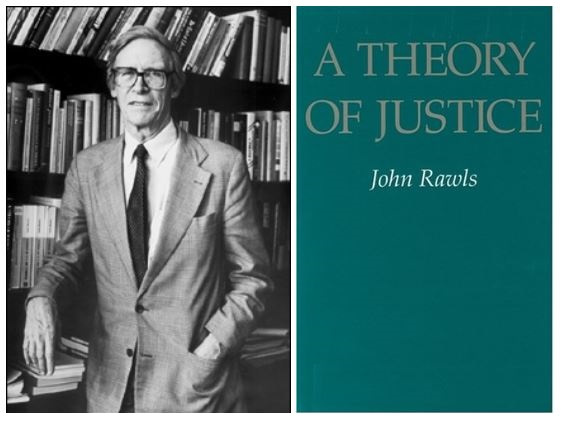
The challenges from the left are more obscure and harder to understand, likely because they are less materialistic and more idealistic and philosophical. In chapter 4, “The Sovereign Self,” Fukuyama makes the argument that autonomy has been taken too far by the political left to the point that we’re essentially all self-interested people, worshiping at the altar of our Rousseau-ian inner “selves,” which Fukuyama argues turns us away from the public-mindedness that we need to have to run a democratic republic. I found this point ultimately obscure and unconvincing, but I did find his history of this progress – from Martin Luther to Rousseau, to Immanuel Kant, to John Rawls – to be fascinating. It reminded me of Allan Bloom’s The Closing of the American Mind – an interesting account of our turn from civic-mindedness to self-involvement and even relativism. John Rawls, in particular, comes in for hard treatment from Fukuyama (as he did in Bloom’s book). I have never read Rawls and had thought of him as perhaps being the touchstone of the progressive left – the philosopher of redistribution. But for Fukuyama, he’s more than that – he’s the philosopher of non-judgmentalism, of value-free society, and above all, of relativism. This was a surprise to me, but, after all, I’ve never read Rawls, so what do I know?
I once knew a coworker who’d started as an English teacher but then veered into Special Education because she wanted to better understand how to support all of her students, and this new background proved advantageous for helping all. The longer I teach, the more I can appreciate this desire. For me the desire is a little bit different: the longer I teach, the more I realize that I need to know more – not just about the means of supporting students, but about the ultimate ends toward which I want to instruct students in the first place. Specifically, I need to know more about the type of society – which is to say the vision of the good life – toward which we should aim our educational goals.
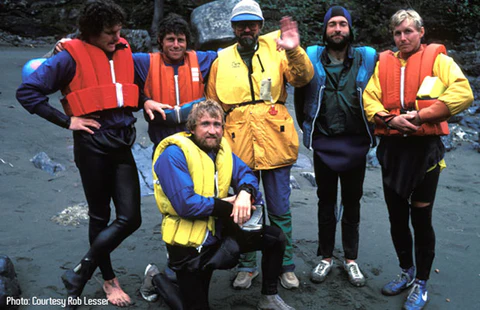
Perhaps inspired by Dane Jackson’s recent set of videos from his stint at the Grand Canyon of the Stikine in British Columbia (often thought to be the hardest, most committing regularly-run kayaking river in the world), I’ve found myself obsessively watching all of the Stikine footage I can. I am drawn back most to the first two legendary descents: The 1985 raft and kayak descent, and – especially – the first descent in August 1981, four months before I was born.
I thought I’d take a slight detour away from Bloom and into a related set of authors: Grant Wiggins and Jay McTighe. Thinking about the way I’ve been taught to begin every student learning objective with the word “understand” (as in, “Students will understand . . . ”) is surely something “rooted in” (as the critical theorists would say) Bloom, but something I dimly recalled being straight out of Wiggins and McTighe – especially their popular ed book, Understanding by Design.” So I thought I might revisit that book to see how it aligns with Bloom.
As it turns out, Wiggins and McTighe are an especially interesting companion to Bloom – they are explicitly carrying on his legacy, building on his work, speaking in conversation with him, modifying him, and sometimes adapting him to suit new purposes. Plus, I’m fairly sure this is where that “students will understand” dogma that I was taught probably comes from – I’d forgotten what a central feature it is in this book. But how do they define “understanding”? And how does it relate to Bloom’s goals?
One side note before I dive into the book: As I remembered from my first read-through some years ago, I really enjoyed re-reading Understanding by Design. I appreciated the focus of Wiggins and McTighe’s work on identifying the most important and worthy goals in education and pursuing them with clarity. I appreciated their connection to and clear familiarity with the seminal figures in education (they often quote Dewey and Bloom, for instance), and their constant real-world examples.
At the same time, as I started re-reading, I remembered something more negative from their work, as well: For two authors so focused on clarity, Wiggins and McTighe are often surprisingly unable to define what they mean regarding the basic concepts of their philosophy. This is nowhere more clear than in their repeated – shaky – attempts to define “understanding” – for them the core, critical goal of education.
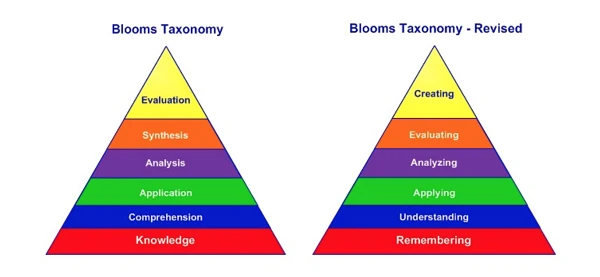
Bloom’s Taxonomy. I can’t remember the first time I heard this famous phrase, but it was surely no more than a few feet inside the door of my first graduate school education class. Bloom – Benjamin Bloom, the iconic University of Chicago researcher – published his famous taxonomy of educational goals back in 1956 and few educational materials have cast such a large shadow. I can’t tell you how many times I’ve heard a presenter refer to it as gospel, or all the times I’ve been handed some brightly colored, pyramidal visual graphic of it, or even that ubiquitous spinning wheel thing with all the verbs on it. I’m sure I’ve got six or seven kicking around in the bottom of my desk.
It’s not surprising, then, that I’ve come to believe over the past few years that Bloom’s taxonomy represents another one of those invisible boxes that I’ve been operating inside, without realizing it – some useful but ultimately unexamined confine. I began to have this feeling that for anyone thoughtful about designing educational experiences, the taxonomy is sort of the water we don’t know we’re wet in.
Ross Douthat of the New York Times had an interesting column last week about the state of liberalism today. Douthat’s main thesis is that the strict proceduralism of a liberal order, while useful for facilitating pluralism, isn’t existentially or spiritually nourishing. In Douthat’s words, liberalism “depends on constant infusions from other sources, preliberal or nonliberal, to generate meaning and energy and purpose.” While Douthat doesn’t define liberalism, one can infer that he is talking about the Enlightenment-era system of formal laws and informal norms, political and economic, that aim to promote the freedom and equality of the individual. That is — our Madisonian system of checks and balances, our legally codified system of individual rights, and our capitalistic economy.
What is the origin of the divide between today’s political Left and Right in the United States? It’s a fascinating question, and according to Yuval Levin, in his book, The Great Debate, which I’ve just read, the modern Right-Left debate originates in the conflicting worldviews of two non-Americans: Thomas Paine, representing the origins of the Left, and Edmund Burke, representing the origins of the Right.
Thomas Sowell’s contention in his book, A Conflict of Visions, is that the origin of this division is a fundamental disagreement about the basic moral capabilities of human beings. Those who believe humans are fundamentally capable of great achievement beyond the ordinary scope of human behavior – especially in the form of moral sacrifice or altruism – tend to fall on the political Left, while those who believe humans are inherently constrained and limited tend to fall on the political Right.
One specific that I’m not sure Sowell touches on – but that Levin does – is the question of exactly why those on the “unconstrained” side view humans (or at least some humans) as being capable of extraordinary moral achievement. This is where Levin’s outline of the political vision of Thomas Paine, patron saint of the political left, according to Levin, is particularly useful.
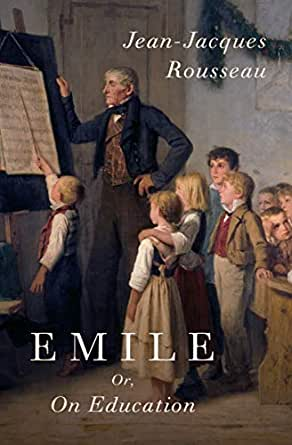
Several years ago, I tried to read Emile, Jean-Jacques Rousseau’s uber-classic and revolutionary book on education. I got about halfway before I had to abandon ship, and I managed only one short blog post about what I’d read. It was too much. Rousseau is a spectacular writer, but the book is long, formless, and almost too rich to digest all at once. Each chapter, each page, has so much on it; when I gave up finishing it two years ago, it was with the clear sense that I knew I’d return in a few years once I was more ready. Now it’s the time.
I just picked it up again the other day and read the preface and the first chapter – I’m taking it slowly this time – and I was absolutely amazed at how extraordinary this book is. It is completely mesmerizing and absolutely foundational as an educational text that influenced the way we conceive of schools down to this day. I once read a quote that said Plato’s Republic and Rousseau’s Emile are the only two books you really need to read in order to understand our modern educational controversies. After reading even this short section of Emile again, I think that author may be correct.
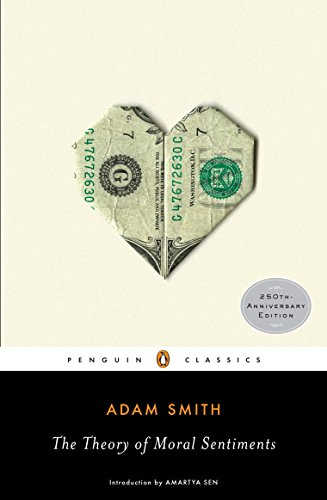
After spending some time reading first Freire and then Marx, trying to determine their understandings of human nature, I figured it was high time to read someone with a totally contrasting view, and who better to contrast with the sage of communism than the high priest of capitalism, Adam Smith? Instead of his more famous – and lengthy – work, The Wealth of Nations, I thought I might start with his lesser-known The Theory of Moral Sentiments (TMS). I made this selection not only because the title promised more direct access into Smith’s view of human conduct and human nature, but also because I’d encountered intriguing quotes from TMS in more than a few books I respect.

 he
he